
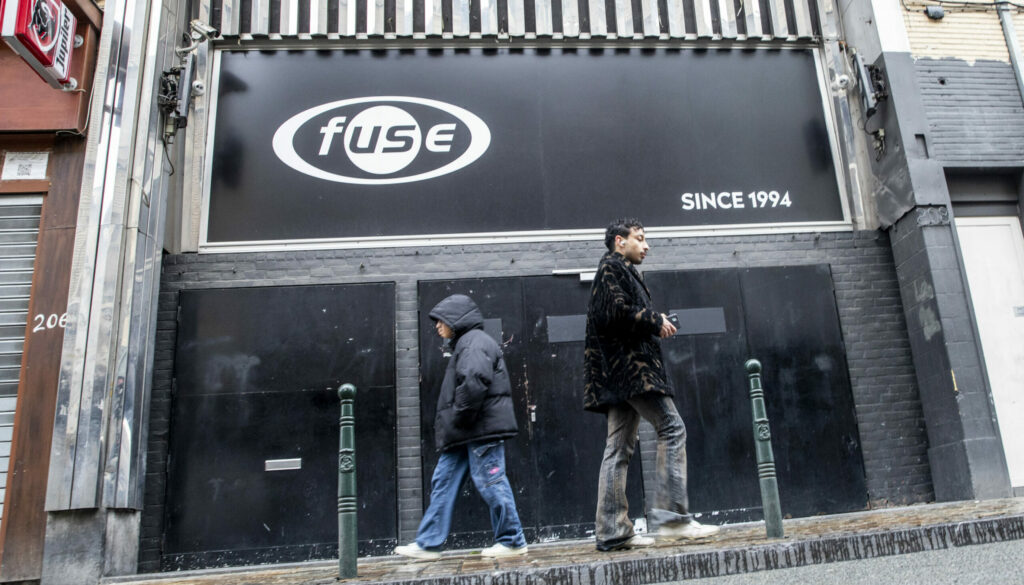
Brussels institution Fuse is introducing a strict no-phone policy on its dance floor.
The move, announced on social media last week, aims to preserve what the club calls a "shared escape" – and follows a similar step already taken by fellow Brussels venue C12.
"When phones appear while dancing, the outside world follows," Fuse (Rue Blaes 208) wrote in a statement published on Instagram about a week ago. "The dancefloor is a shared escape. One screen can break the spell for more than one person."
From now on, the club will operate under a no-phone policy on the dancefloor. Guests who need to send a message are asked to step off the floor and keep it brief.
"The best moments don’t need proof. It’s about the floor, not the feed," the statement continues, framing the measure as a small but meaningful gesture to create a space that feels "safer, freer, and more welcoming for everyone."
In an era where clubbing is often mediated through Instagram stories, Fuse is betting on intimacy over visibility. "A club is an intimate space to be lived, not observed," it wrote.
Not a first in Brussels
Fuse is not the first Brussels-based club to take this route. C12, a night-club located in the city centre (Rue du Marché aux Herbes 116) has enforced a similar policy since February 2023.
There, party-goers have their smartphone cameras taped at the entrance, inspired by Berlin’s privacy-focused club culture where phones are widely viewed as a distraction from the dancefloor ritual.
At C12, the only exemption is granted to the in-house photographer, allowing clubbers to access professional images without turning the night into a sea of glowing screens. Offenders risk warnings and, in repeated cases, would be denied entry.
The broader trend reflects a growing push within European nightlife to reclaim dancefloors as ephemeral, camera-free zones – a reaction to years of social media saturation and concerns about consent, privacy and immersion.
A club that fought to survive
In January 2023, the club was forced into temporary closure after Brussels Environment imposed a 95-decibel limit and a 02:00 closing time following noise complaints from neighbours. The decision sparked protests and ignited a citywide debate about the future of nightlife in the Belgian capital.
Fuse eventually reopened in March 2023 under a new agreement allowing late-night operations twice a week, on the condition that it resolves its noise dispute within two years - potentially by relocating. Since reopening, three additional complaints have been lodged, prompting concerns from authorities that violations had worsened.
Yet the crisis also highlighted the club’s cultural weight. Within months of the closure, Fuse and around 20 other venues were recognised as intangible cultural heritage, acknowledging their economic, social and cultural importance to Brussels. Mayor Philippe Close (PS) publicly called for a balance between residents’ peace and the city’s cultural life.
Relocation remains on the table. One option reportedly under consideration is the "Palaces" site beneath Brussels-Midi station, a more secluded location that could mitigate noise conflicts.
