
Maxime Prévot returned to Brussels on Friday evening after a week-long mission to the Western Balkans, during which he expressed strong support for the region’s European aspirations while acknowledging its complex realities.
The Belgian Foreign Minister began his visits in Montenegro and concluded with a poignant stop in Srebrenica, where over 8,000 Bosniaks were killed by ethnic Serb forces during the 1995 genocide.
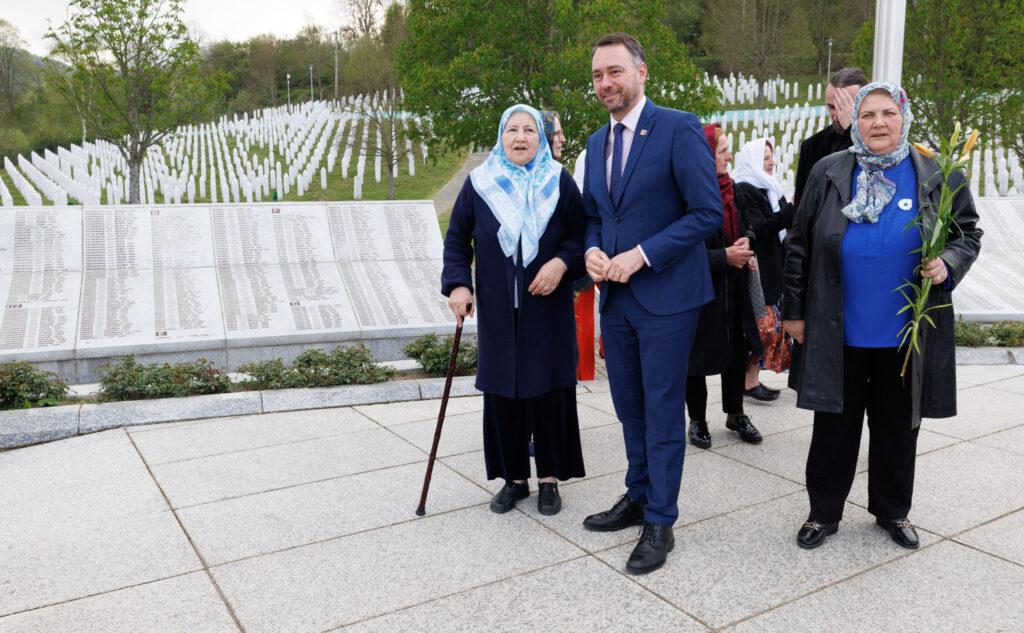
In Srebrenica, Mr Prévot met with mothers of the victims who shared their deeply moving testimonies. Together, they paid their respects at the entrance of the vast cemetery of white stone graves, facing the genocide memorial.
“Being here is about remembering, learning lessons, and looking to the future with a renewed commitment to diplomacy, which exists to prevent conflict,” Mr Prévot stated. He had travelled to Srebrenica aboard an EU peacekeeping force helicopter.
Earlier in Sarajevo, the minister laid flowers at a memorial honouring the five Belgian soldiers who lost their lives in Bosnia between 1992 and 1999.
Despite the war in the former Yugoslavia officially ending 26 years ago, tensions remain high in the region. An expert observer described Bosnia and Herzegovina as “a volcano—calm on the surface but capable of erupting at any moment.”
The situation in Kosovo, one of Mr Prévot’s final stops, also remains fragile. The country faces enduring political deadlock, prompting new elections. Tensions between Kosovar and Serbian communities persist, particularly in the north, and hopes for normalising relations between Pristina and Belgrade appear increasingly distant.
Though Kosovo’s independence is not recognised by five EU member states and it lacks official candidate status for EU membership, Mr Prévot believes its accession remains “a credible prospect.” During his visit, he held discussions with Kosovo’s President, Vjosa Osmani.
Throughout the week, Mr Prévot consistently emphasised the importance of European integration, visiting Podgorica, Sarajevo, Belgrade, Skopje, and Pristina.
“The Balkans are crucial to the stability of the European continent. We must give hope to these nations, whose populations overwhelmingly support the European Union,” Mr Prévot said. “If we allow them to feel snubbed by Europe, it would leave space for Russian narratives to gain ground.”
He noted the urgency of fostering strong relations within Europe. “We are at a geopolitical moment that demands care for our neighbours. Europe cannot aim to become more independent, to develop strategic autonomy, and to act as a geopolitical superpower while focusing solely on other continents.”
Mr Prévot said his discussions with regional leaders revealed strong awareness of the connection between their futures and that of the European Union. “They understand this is a merit-based process that requires significant reforms. They are resolved to act. The time to deliver is now,” he added.
