
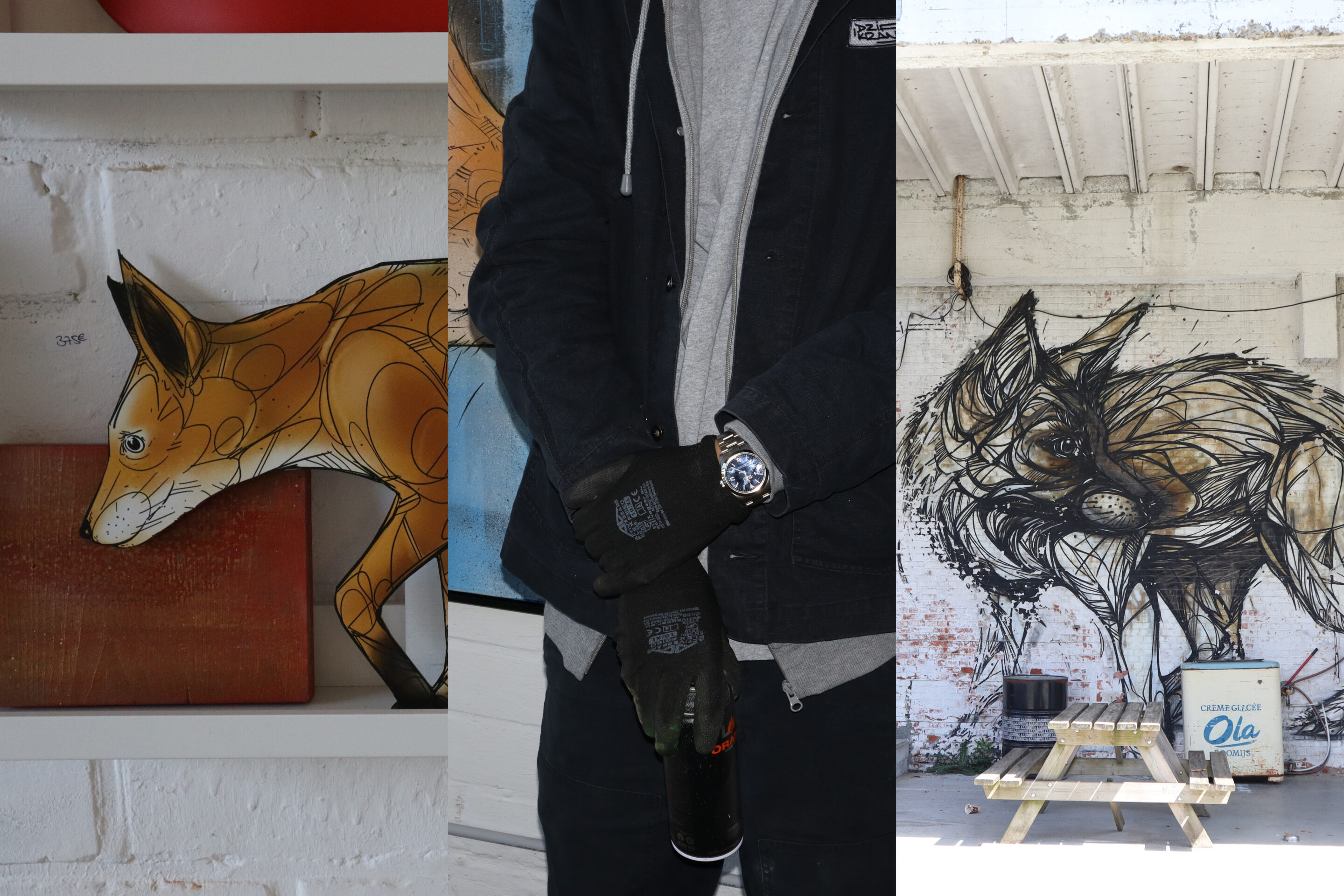
If you haven’t heard the name Dzia before, you still might have glimpsed his work painted on walls across the country.
Dzia is one of Belgium's most iconic Belgian street artists. His various depictions of animals are everywhere – from small town Belgium to Brussels, Antwerp and Ostend. Further afield, London, Mumbai and Shanghai are all home to his projects.
The Brussels Times met Dzia at his improvised gallery-workspace at Vilvoorde's Kruitfabriek. It’s a massive industrial building – the gold standard for a street artist. The space served as an artist shelter for different creative projects lacking a place to be, but most of the rooms are now dormant, waiting for a new life.
Dzia, despite his fame and many commissions from the Flemish government and private clients, has to move studios every few years. This time, he managed to secure the place for around a year on a so-called “anti-squat” contract.
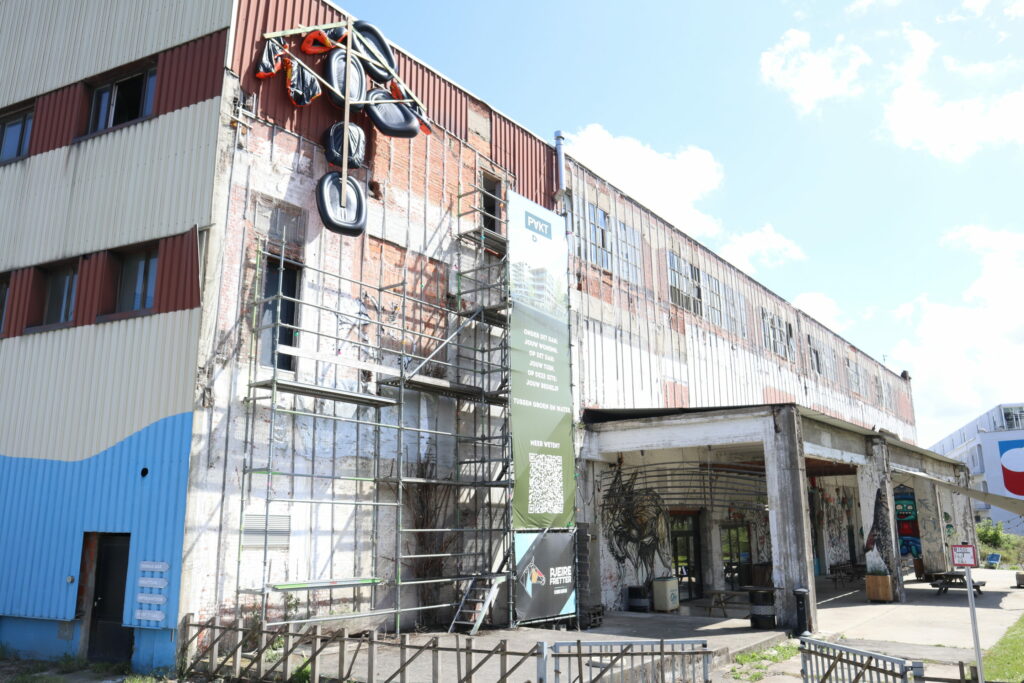
Kruitfabriek in Vilvoorde, where Dzia's new studio is located. The artist sometimes does open studio days, when everyone is able to visit. Credit: Kosmos Khoroshavin / The Brussels Times
Dzia’s artistic roots in Antwerp
Dzia says the origin of his artistic name is "not that deep" and that it "simply sounds nice". It was only later that he learned that his tag resembles many words in different languages – with the Polish word, dziadzia (grandpa) as one example.
He chose the name during his years spent DJing after graduation from the famous Royal Antwerp Academy of Fine arts, the alma-mater of the Antwerp Six.
Coming from a supportive family of Flemish artists, he first chose to study architecture at a different university. Despite quickly switching to fine arts, it is clear that Dzia’s interest in buildings has profoundly impacted the way he blends his subjects within the environment.
“The academy for me was always about public art," he tells us. "It was very diverse. You had all these mediums without concrete specialisation like sculpture or painting. More like an all-round mixed media course. It helped me a lot to develop as an artist."
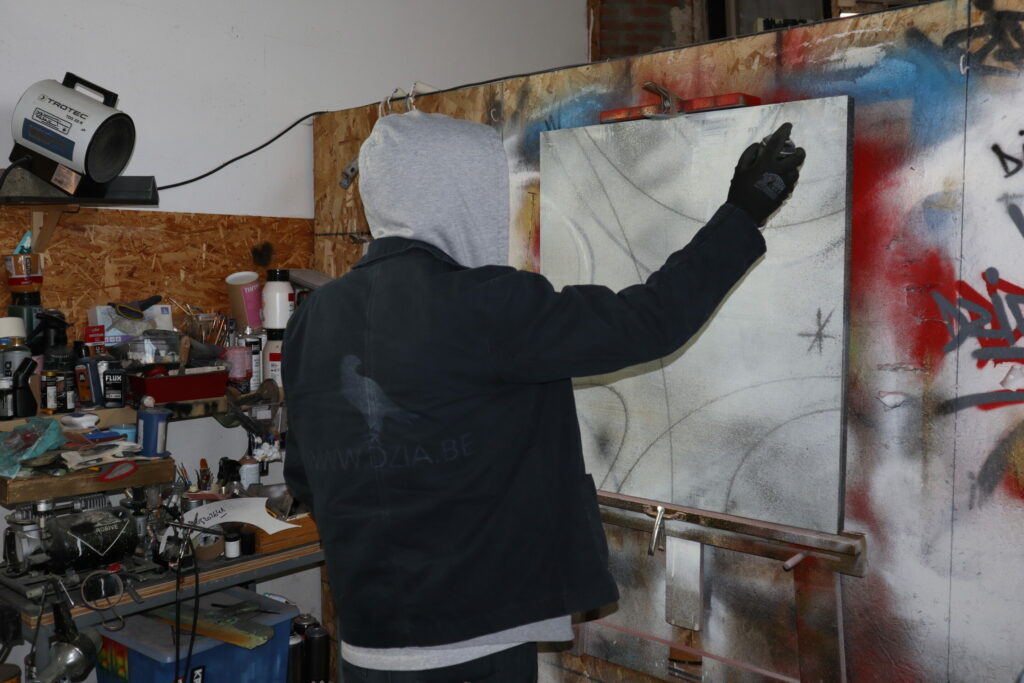
Dzia at his workspace in his studio. Credit: Kosmos Khoroshavin / The Brussels Times
So was it all sex, drugs and rock 'n' roll in Antwerp during the 2000s?
“It wasn't that bohemian – of course not," he says. "We had some good parties and you could go to a nice cafe to drink with your teacher and spend the whole night talking about art. That’s about it.”
While speaking warmly about his time at university, Dzia believes that going to an art school is not a must in the modern age.
“A lot of people now are autodidacts – they learn by themselves or are just passionate…obsessed about art. They might not need experience of going to an academy but some things like art history are very helpful – then you don’t have to reinvent the wheel again,” he says.
Suburban animals
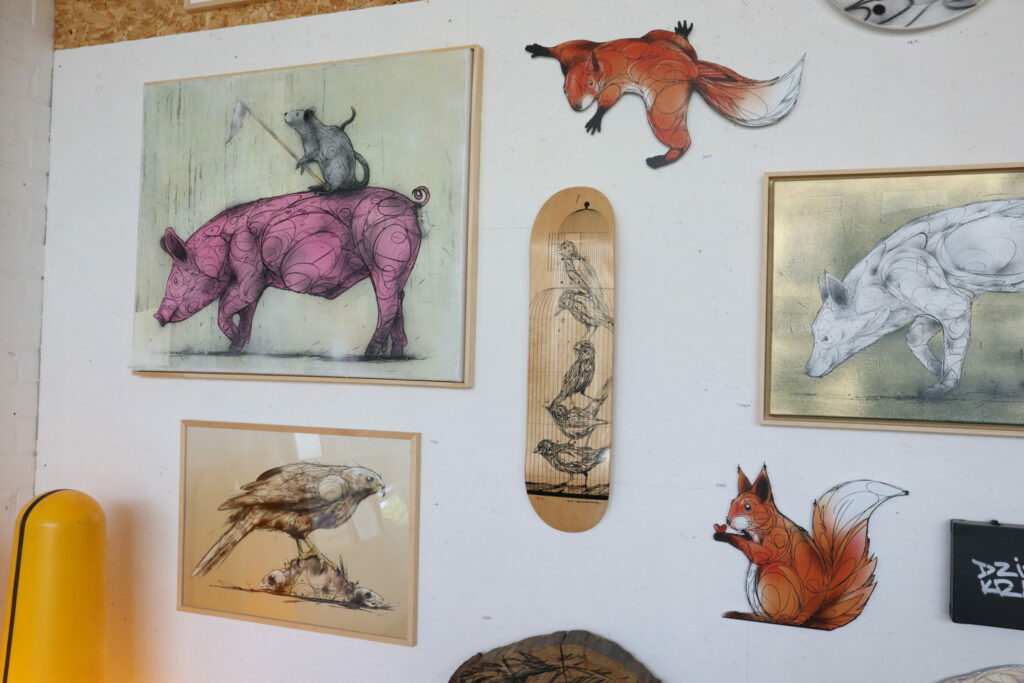
Credit: Kosmos Khoroshavin / The Brussels Times
What gives Dzia’s works their prominence is the combination of an easily recognisable free-hand style and the appeal of drawing animals in a suburban environment. Vibrant colours printed on gritty textured surfaces are accompanied with thick black outlines, and dynamic circular shapes.
“It took me 10 to 15 years to develop this style," he says. "I was triggered by the places where I was painting. I saw a lot of urbex settings: old schools or factories, where nature took over the place. At that point, I started drawing these animals.”
“I was looking for an easy way to produce them in a stylised way, not a photorealistic one. Then you get an expression of the animal and dynamism. These black lines, the points and structures around the image create an energetic play. Another important thing is the expression in the eyes – it captures the soul of the animal.”
His most iconic animal is the fox, which he says is one of the last big mammals able to catch up with the rhythm of our cities. “They're very inventive so they have their ways to survive in an urban setting, like Brussels. I painted one of my first ones here, in Kruitfabriek.”
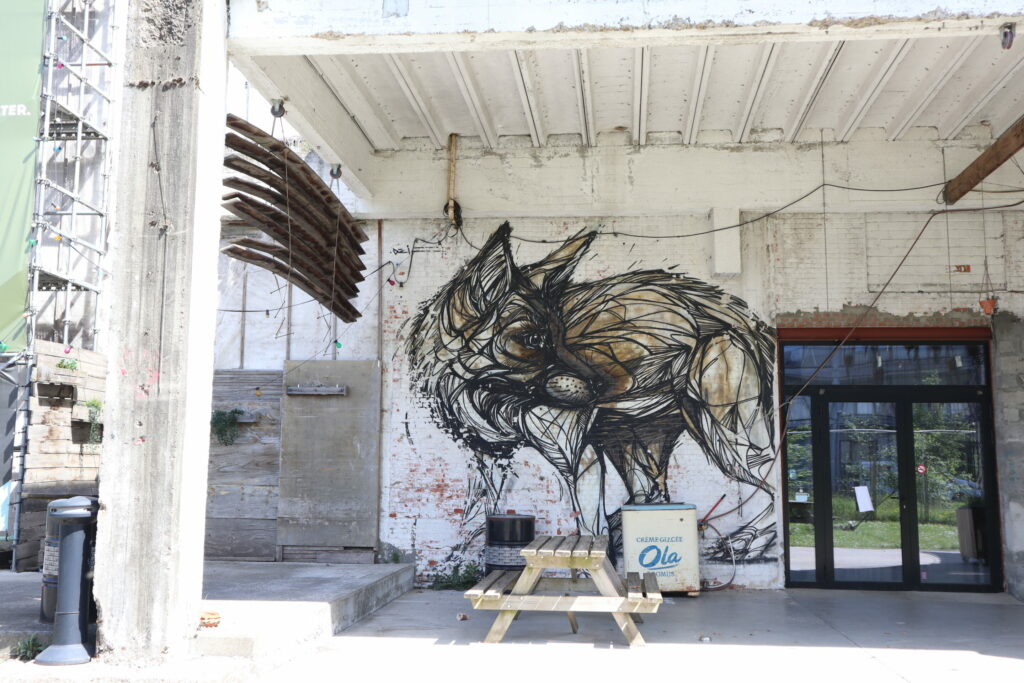
The golden fox was one of the first foxes painted by Dzia. Credit: Kosmos Khoroshavin / The Brussels Times
While developing his own way of working took a while, Dzia says he can complete murals in just a day or two.
“I try not to do much research in advance when I paint. I use references from wildlife photographers. Painting with spray paint is rougher than drawing in a studio, so I always decide how to capture an animal right there and then, sitting, standing or moving. And of course I make sure they blend in well into the location.”
Dzia has painted all over Belgium, but the choice for a mural’s location is not that obvious. While he loves big cities like Antwerp or Brussels, a city he notes for a constant sense of change, he finds that these places are not where his work is most needed.
“I love painting in small villages, because I think it has more impact than if you paint something in a city. It might not be that important for the street art scene, but the people are more triggered by it,” he explains.
“In the past it was really important to go to Paris, London and New York to paint some walls there. Nowadays, I think it’s cooler when people just go for a walk and then they discover a new artwork of mine in the bushes or a dead end street.”
However, Dzia did go to many of these places and left his mark there. His destinations included Mumbai in India, where he was invited by the Belgian embassy to paint a mural in one of the most well-known slums of the city, together with local children.
Wherever he went though – whether the South of Italy or Norway – he felt something within him calling him back. “It's really important to go to another country once or twice a year and paint there. You start appreciating how good it is to be a Belgian artist.”
The future of art
Unsurprisingly for a street artist, Dzia is not a big fan of fancy galleries or art markets. However, the reality of living as an artist in 2026 is not always easy. Dzia has worked with Converse, Inno, and the Flemish government.
“I'm living from my art, so I need to do commissions," says Dzia. "As long as you can work in your own style and push your own concept, the company or the product you're working with is aligned with your values, there is a way. You always find a balance between commercial stuff and something you want to do for yourself."
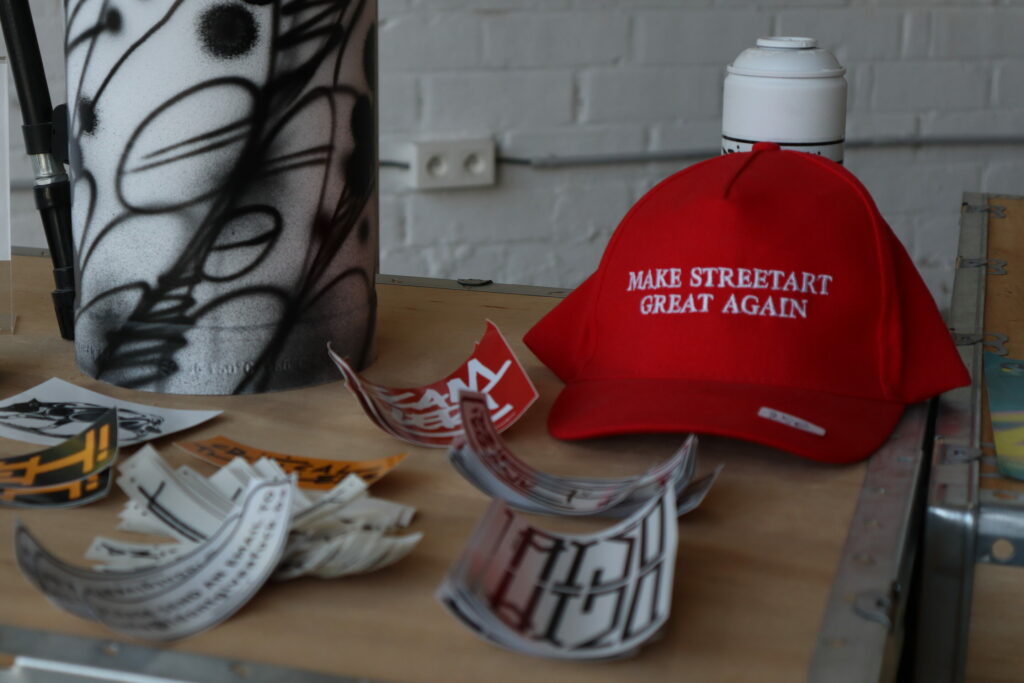
Dzia's stickers and a provocative cap, which mocks the MAGA slogan. It turns it into criticism towards gallery owners. Credit: Kosmos Khoroshavin / The Brussels Times
He adds: “You can work a separate job or find subsidies, but the idea is the same: to pull finances from somewhere. I think I found the right balance and I don’t feel like a sellout. I am always consistent and go with my own vibe for the projects.”
Dzia circles back to Antwerp’s Royal Academy and says he wishes they had more practical classes on monetising works and networking, something he feels is needed in today’s tough labour market.
He seems nostalgic for the rougher, raw street art scene of old, revealing that most young artists are now painting only at festivals, with a brush in hand, not a spray can.
Still hiding his face from the cameras even after all these years, Dzia tries to stay true to himself. “I consider what I'm doing to be more in the realm of street art. Yes, it’s legal, but the way I do things – it’s pure,” he says.
“Art is about emotion, communication and expression. And as long as there's expression – there's still love in this world. That’s really important.”
