
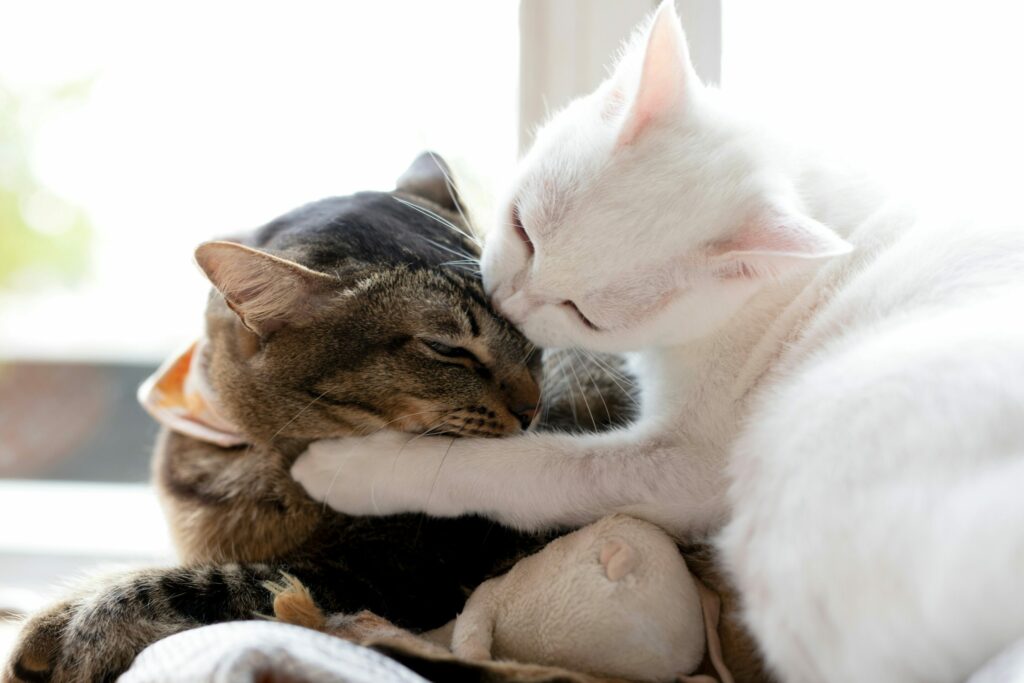
What could be cuter than two cats grooming each other, right? Well, according to a new Belgian study, these sleek movements might not just be kisses – but a form of bullying.
Research conducted at Ghent University suggests domestic cats can weaponise licking to irritate or intimidate fellow felines without starting an outright brawl.
Morgane Van Belle, an animal behaviour researcher from Ghent University, initiated the study after observing a curious dynamic between her own pets.
Whenever her cat Fabio claimed a nice sunny spot, his companion Giovanni would approach and begin aggressively licking him. But she noted that the continuous attention was annoying rather than loving. Fabio would eventually abandon the warm patch, allowing Giovanni to take over the space without any real cat-fight.
To investigate whether this was a systematic feature of feline behaviour, Van Belle’s team analysed video footage of 106 cats across 53 households.
Owners with cat pairs were asked to record everyday interactions at home. Meanwhile, researchers monitored 23 distinct behavioural markers like ear position, posture, movement, and physical contact.
Historically, experts viewed the practice as a primary indicator that two animals belong to a shared social group or serving hygienic purposes. Grooming usually targets hard-to-reach areas like the head, neck, or ears. However, during these friendly exchanges, subjects lay close together and often fell asleep or engaged in mutual play-fighting.
Tense encounters paint a different picture. One animal would typically lean heavily over its peer. The recipient often displays clear signs of distress – flattening ears, licking lips, shaking its head, or attempting to escape the interaction entirely.
Instead of providing a helpful cleaning service, the dominant feline applies forced hygiene as a coercive tool. Researchers concluded that licking serves as "a subtle agonistic signal to covertly solve conflict."
Van Belle noted that to her this is not a sign cats' general animosity, but an intelligent way to avoid conflicts.“They have these very subtle ways of resolving conflict. To me, that shows they are intelligent and flexible in their behaviour, rather than simply being jerks," she told The Times.
