
Belgium's population is growing, but the country's birth rates wouldn’t show that. 2025 marked the fourth consecutive year in which more Belgians died than were born, yet Belgium's population still steadily increased during that same period.
This contradiction has an explanation – migration.
Belgium recorded 108,033 births and 112,923 deaths in 2025, meaning nearly 5,000 more people died than were born that year. However, the country's population still grew by 42,083 people due to migration.
A total of 177,094 people moved to Belgium during the year, while 129,532 left – producing a net international migration balance of 47,562 people.
That balance was considerably lower than in 2024, when Belgium recorded a net migration gain of 66,044 people, 28% more than in 2025. Despite the 2025 decline, migration to Belgium still offset the country's natural population loss almost ten times over.
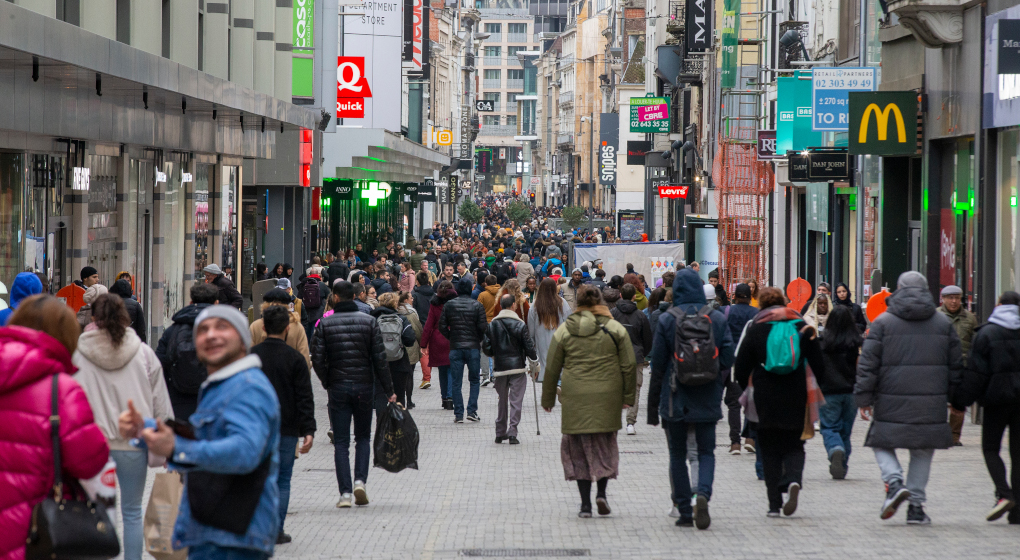
Central Brussels. Credit: Belga
The demographic breakdown of migrants has also changed.
Last year, Romanians were the largest nationality group immigrating to the country, followed by French nationals. Ukrainian nationals accounted for only 9,542 (or 5.4%) of immigrants – a big change from just a few years prior, when Ukrainians made up 24.6% of all the immigrants in 2022 (when Russia launched its invasion on the country).
Emigration rates, however, have remained stable. Last year, 129,532 people left Belgium – an increase of just over 1,000 residents from the prior year. Belgians accounted for 27% of emigrants in 2025, a 17% difference from the second-highest group, Romanians.
Data from the past five years lead to the same conclusion. Migration isn’t just leading Belgium's population growth, it’s preventing the country's population decline. This has not only been the case in Belgium, but it has been an observable trend across the EU.
Data released by European statistics agency Eurostat shows that 19 EU countries experienced population growth in 2024. In over half, including Belgium, positive net migration prevented population decline.
What this looks like in Belgian communities
The effects of migration are not seen equally across the country. The Brussels-Capital Region has the highest concentration of immigrants, with 51.4 international immigrants per 1,000 inhabitants, compared to 9.8 per 1,000 in Flanders.
For communities with larger numbers of immigrants, population growth can lead to greater demand for housing, schools, healthcare and other public services. In regions with comparatively little international immigration, those changes tend to be far less visible.
The economic side of migration is also already part of everyday life. The OECD estimates that 59% of Belguim’s new long-term or permanent immigrants in 2024 arrived through free movement within the EU. Labour migrants accounted for another 7%, while 20% were family members and 15% arrived through humanitarian channels.
While concerns about crime rates have also become part of the broader debate around migration, there is not a single official statistic showing what share of crimes in Belgium are committed by immigrants.
Legal conversations surrounding migration
Despite Belgium becoming increasingly dependent on migration to offset its natural population decline, the country’s Federal Government is simultaneously tightening some of the routes through which people can settle in Belgium.
A recent example is the new and stricter family reunification rules which were implemented last year. The stricter conditions include higher financial requirements and waiting periods in certain circumstances.
Family reunification accounted for 57.1% of residence permits held by non-EU citizens in Belgium at the end of 2023, the highest proportion in the EU by 8.5 percentage points.
This figure doesn’t state that 57.1% of immigrants arriving in Belgium came through family reunification. Instead, it refers to residence permits held by non-EU citizens at the end of 2023. However, it does illustrate the importance of family migration within Belgium's non-EU resident population.
But conversations about migration can’t be reduced to one policy area. EU citizens have freedom of movement within the European Union, while non-EU nationals can enter through different routes, including employment, study, family reunification and humanitarian protection. Changes to one route therefore will not automatically cause an equivalent change in overall migration.
