
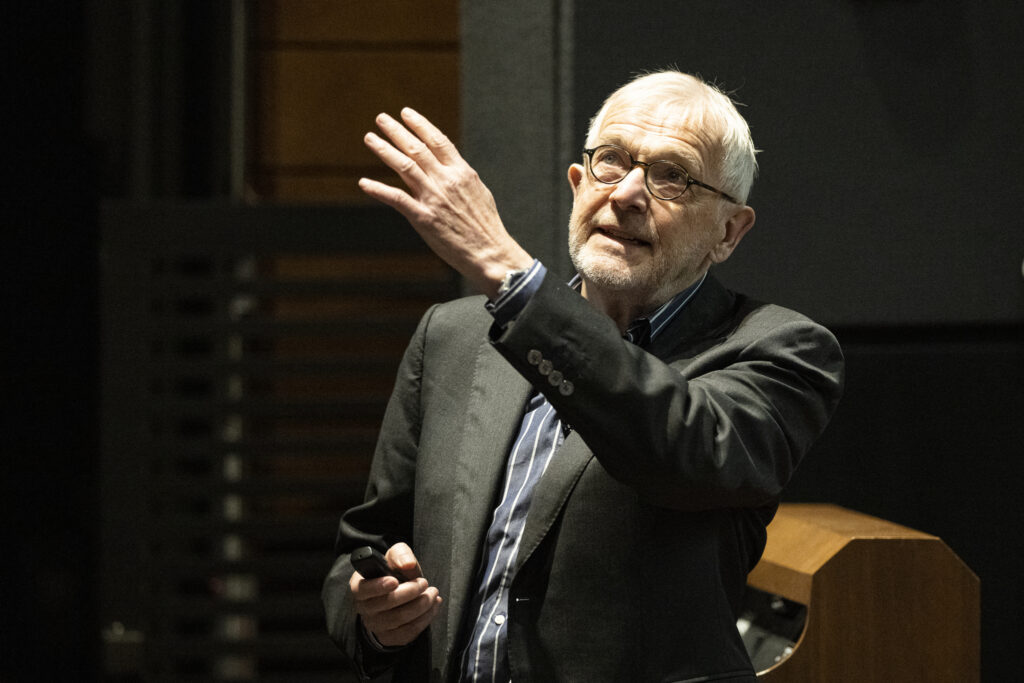
Belgian scientist Francis Halzen never expected to win the Nobel Prize in Physics, instead dreaming of a career as a professional cyclist as a child. "I'm a Belgian, all I wanted was to win the Tour de France."
Halzen showed his humorous side at a press conference in the Italian city of Turin. "Yesterday I was working on the application for a new research project," Halzen told the assembled press. "I hope this prize will help me secure the funding."
Halzen was recognised by the Nobel Committee for his work in the field of neutrinos, known as the ghost particle. Neutrinos are elementary subatomic particles with no electrical charge, almost zero mass, and a tendency to pass straight through ordinary matter.
About 65 billion neutrinos sent out by the Sun pass through every square centimetre of the surface of the Earth every second.
Related News
- Belgian physicist Francis Halzen wins 2026 Nobel Prize
- EU-funded researcher wins 2026 Nobel Prize in medicine
- Nobel Prize money rises to €1 million
Halzen developed the observatory IceCube, which uses 5,484 optical sensors deeply embedded in the Antarctic ice to study neutrinos. Studying neutrinos can give scientists indications of cosmic mysteries like supermassive black holes hidden in the centre of the universe.
Studying neutrinos is intense work, but it has progressed significantly with the rise of neural networks in the past few years. "The first neural networks appeared in the late 1980s," Halzen explained. "I am very proud that, as early as 1991, I wrote an article in which I proposed using AI to analyse data from a classical physics experiment."
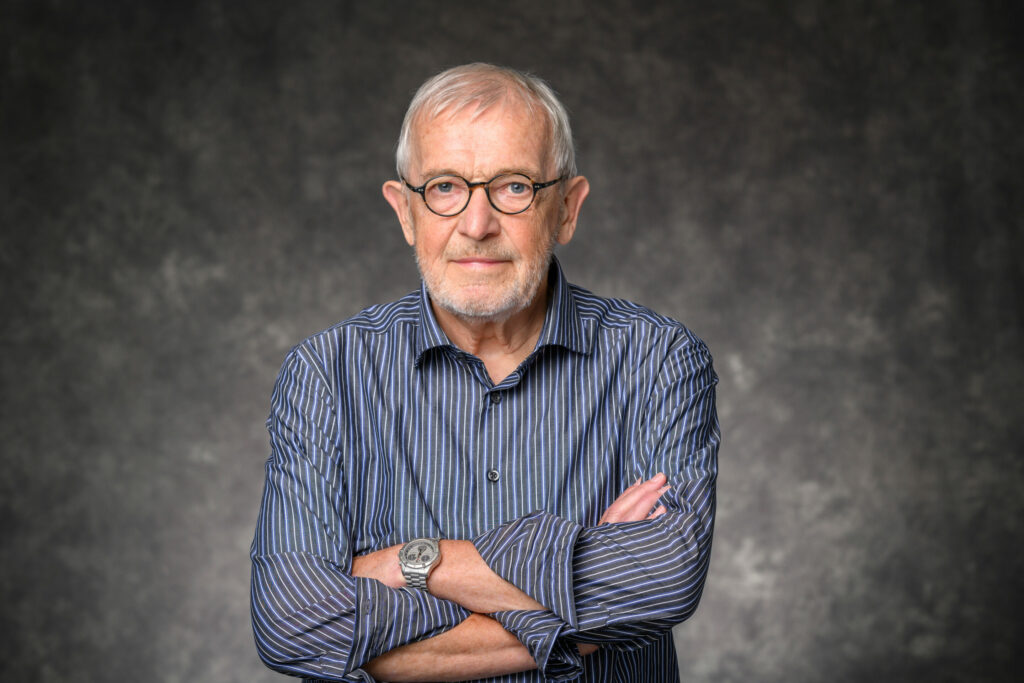
Francis Halzen, principal investigator of IceCube. Credit: University of Wisconsin - Madison
Today, Halzen uses machine learning to detect patterns in massive data sets to identify research results. "We have now identified the Milky Way with certainty. What would give neutrino astronomy a huge boost right now is the observation of a supernova explosion in our own galaxy."
Halzen wants to use his award to emphasise the importance of funding scientific research. His research spanned 35 years and cost around €250 million, primarily funded by the American National Science Foundation (NSF).
"Universities are in a constant survival mode, and scientific research has become more difficult. But I’m the last person to complain about that, as my project was protected," the scientist joked.
