
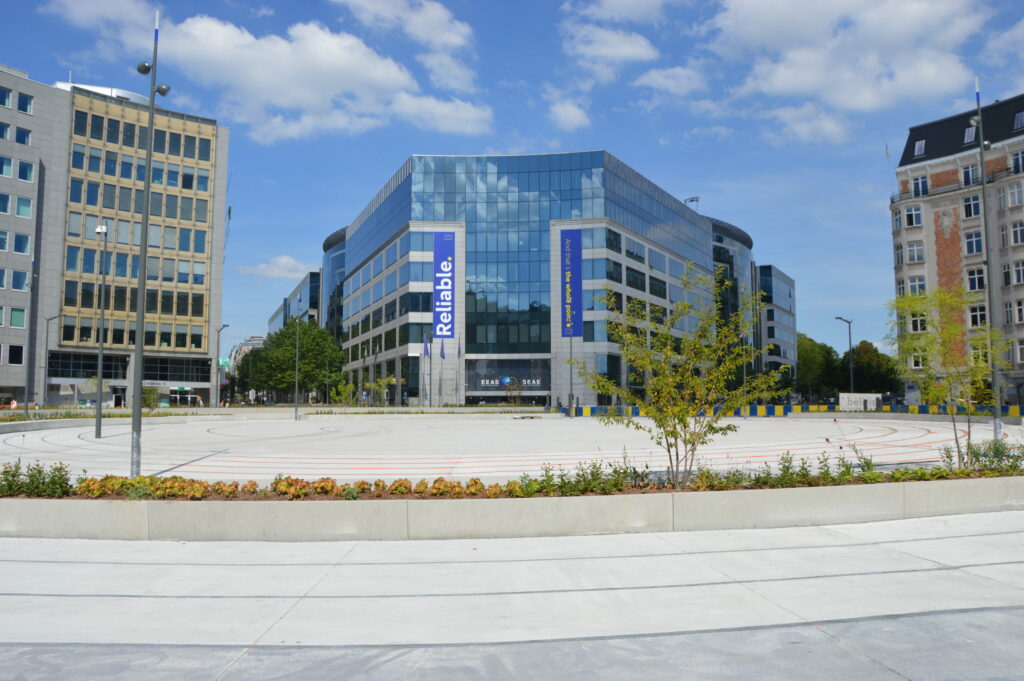
The debate over Brussels' newest square has become surprisingly emotional. The Schuman roundabout was expected to be bold and distinctive, but at some point along the line, someone said "scratch that".
We have been left with something that is – in many people's minds – plain old ugly.
The discourse on the roundabout raises an interesting question: why do squares, buildings and public spaces provoke such strong feelings? Surely beauty is just a matter of taste?
How the brain responds to beauty
Maybe not. Ugliness is more than just an aesthetic opinion. There is a fascinating new field of research called neuroaesthetics, which looks precisely at what happens inside our brains when we look at beautiful buildings, art, music or design.
Research suggests that when we're surrounded by beauty, our brains don't just clock it and go, "Yeah, that's nice”. Rather, they can react with something much closer to a spontaneous "PHWOAR!".
It turns out that beauty isn't simply something we admire with our eyes – we respond to it with our whole body. When we see something beautiful, our brain releases a cascade of chemical and electrical signals linked to pleasure, attention and emotion. We soak beauty in, and our bodies respond: our heart rate and blood pressure can fall, our mood lifts, we concentrate more easily, and even feel less stressed.
Conversely, when we're confronted with something bleak, stark and dull, such as the Schuman roundabout, we experience none of this. Instead, such places can leave us feeling slightly more vigilant, less engaged and more inclined to move on.
How architecture influences us is one of the things that scientists are studying. It seems that people often respond more positively to buildings and spaces that are designed with the intention of offering shade, shelter and a break from noise; spaces that are not overwhelming and that are well lit, and rich in natural materials.
Obviously, beauty is in the eye of the beholder and all that, but according to neuroaestheticians, we tend to respond pretty similarly to spaces around us. This may explain why certain places feel naturally calming, while others feel strangely unsettling to most of us.
Poor design leads to mental strain
Which means that possibly, beautiful public spaces are a form of social health. Welcoming places can strengthen identity, attachment and civic pride, which in turn fosters community interaction. En revanche, poorly designed spaces tend to be places people pass through rather than gather in, mostly because they put a mental strain on us.
Think of Brussels-North station. I don't know about you, but I walk through it with my shoulders tense, fists half-clenched and eyes scanning every corner as though I'm a meerkat on alert. Now imagine if Brussels-North were more like Antwerp Central Station. I'd be sauntering through it contentedly, half expecting a flash mob to break into dance and getting me to join in (I got carried away, I’m listening to LaLa land as I’m typing this).
What I want to say is that beautiful surroundings have a way of stirring awe, joy, and a sense of ease.
Luckily for us living in these times, the idea that our surroundings shape our health is no longer dismissed as woo-woo. Earlier this year, King's College Hospital in London opened the UK's first rooftop intensive care garden, allowing critically ill patients to spend time outdoors while remaining connected to life-support machines. The hospital is now studying whether something as simple as fresh air, daylight and greenery can help people recover.
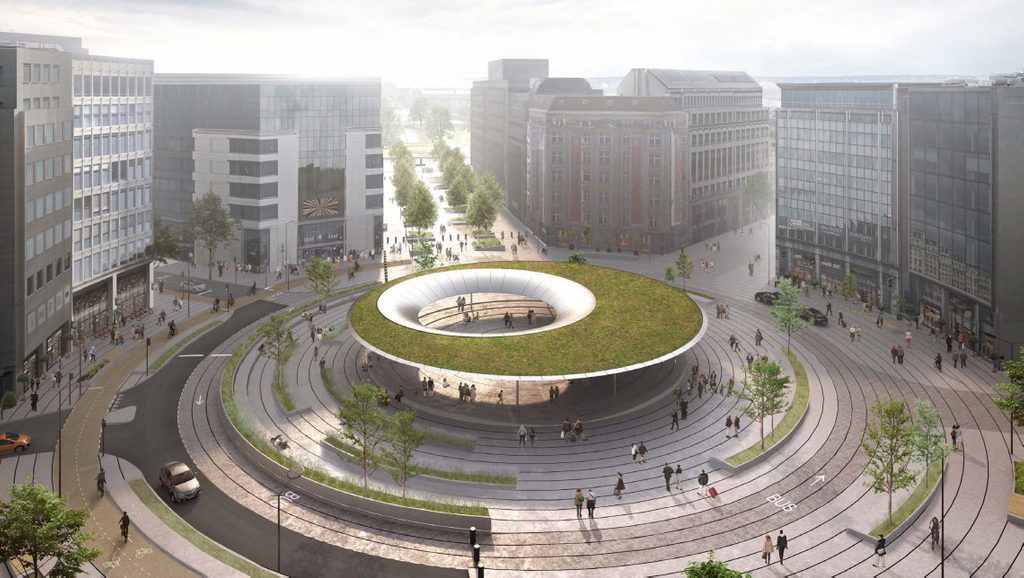
How the roundabout was supposed to look with the planned canopy installation. Credit: Beliris
Back to the beginning – the Savannah Hypothesis
There's an evolutionary reason for all this. Modern humans have been around for roughly 300,000 years. Dense towns and cities have existed for only the last 10,000 or so. In evolutionary terms, that's barely a minute ago. For almost all of our history, whichever continent we lived in, our brains were shaped by landscapes of trees, rivers, open horizons and changing seasons.
Sunrises and sunsets rose and set uninterrupted. There were no concrete towers breaking the skyline, no sprawling stark roundabouts, just the beauty of the natural world.
In fact, there is a fascinating idea known as the Savanna Hypothesis, which suggests that, across cultures, humans may share a preference for landscapes that resemble the environments in which our ancestors evolved: open views, scattered trees, water and greenery.
It remains debated, but it raises an intriguing possibility: that some of our aesthetic preferences may have deep evolutionary roots. I can certainly say that when I first set foot in the Serengeti in Tanzania, something inside me stirred, as if my entire perspective shifted. I’d say there is still, somewhere deep within me, a pull to return.
But it is not only the natural landscape that has shaped us. As humans, we have always been builders and shapers of our surroundings. The megaliths of Wéris here in Belgium are a reminder of that, as are Malta's prehistoric temples, and the UK’s Stonehenge. They show that our relationship with architecture goes back thousands of years.
We have never built merely for survival: we build places that instilled awe. Fast forward thousands of years, and Vienna offers a fascinating modern example. It is consistently ranked among the world's most liveable cities. Is that because of its architecture? Yes, in part. Of course, a beautiful city cannot compensate for loneliness, poverty or chronic illness. But it can create the thriving conditions that support wellbeing.
This is precisely the philosophy of Danish architect and urban designer Jan Gehl, who has spent decades arguing that we should design cities for people, not just for cars. His work has helped reshape urban thinking around the idea that streets and squares are not merely routes from A to B, but places where human life unfolds. Surprise, surprise, Denmark consistently finds itself near the top of the global happiness rankings.
So perhaps the question about Place Schuman is not simply, "Is it beautiful?" The question we need to ask is: "How does this place make us feel?"
A roundabout is never just a roundabout. A square is never just a square. These are the stages on which our everyday human lives unfold. Those who create our public spaces are shaping more than skylines. They are shaping our daily experiences and, ultimately, part of our collective wellbeing. And this is why Place Schuman deserves another look.
Kristina Chetcuti is a registered health coach (UKIHCA) specialising in behaviour change and lifestyle medicine (ELMO).
Related News
- Dear Kristina: 'Are we having enough sex?'
- From Schuman to Midi: How the Brussels 'master architect' wants a quality city
- How Brussels ended up with Europe's most embarrassing square – and what might be done to save it
- 'Uninhabitable' Schuman Square will be 'a symbol for the failure of the city', says architect
