
On the night of Friday 13 November 2015, I was among the first reporters to arrive at the Bataclan concert hall in Paris as terrorists fired on crowds of revellers with automatic weapons, killing 90 people. A total of 137 died in coordinated attacks across the French capital, including three Belgians.
Ten years on, The Brussels Times asked me to tell that story in the first person - not as a news event, but as I lived it: as a 27-year-old freelance reporter, studying politics by day and interning at The New York Times in the afternoons and evenings, who suddenly found himself covering a massacre he could hear but not see.
Reporting through that night, my goal was to get as close as possible to the scene and gather first-hand accounts from those who had been inside. My own observations, along with the testimonies of bystanders and, hours later, victims emerging onto the streets, formed the basis of a first-person account I wrote the next morning, Saturday 14 November. That piece fed into a report that appeared on the front page the following Sunday.
That night, reporting from the streets of Paris, taught me a lasting lesson: the world is real - and its tragedies can reach your doorstep. In my view, that was the message the Islamic State terrorists sought to send that night – and, unfortunately, they succeeded.
These are my reporting notes, annotated for clarity, recorded and taken by hand during that night and written out in full the following morning.
How the night unfolded
As I arrived by taxi at Place de la Bastille at 10 p.m. trucks carrying soldiers were unloading. Security perimeters were being set up in every direction. Army personnel were coordinating with police officers and other security services, their orders changing every few minutes.
“Set up a line here!”
“Don’t let anyone through!”
“Change direction!”
“Now go this way - make a line here!”
“You can let those through - not those!”
Security lines were loosely enforced, and I slipped through. Crossing Boulevard Richard-Lenoir, I found the street deserted, except for a few homeless people no one had thought to evacuate. On a corner, a small bar was still open; about 15 people stood clustered around a television screen, watching in horror as events unfolded barely 150 meters down the road - their beers still in hand.
I walked across the Allee Verte, where the infamous attack on the satirical newspaper Charlie Hebdo had taken place 10 months earlier. It was quiet; only a few people passed by on the pavement.
The atmosphere was calm. In the distance, I could make out the silhouettes of soldiers - helmets on, guns pointed downward - with blue and yellow flashing lights behind them.
As I approached a final stretch of red-and-white police tape, a group of about 10 reporters had gathered, their cameras pointed north. Suddenly, we heard several distinct gunshots, followed moments later by five loud explosions.
It took me a second to realise what they were: the police assault on the Bataclan had begun. We could hear muffled voices in the distance - shouting, screaming - then more shots, two bursts of sustained machine-gun fire, and finally one or two more explosions.
Then there was a moment of silence. It was about 1 a.m. now.
We saw a line of police officers, a line of soldiers, and a line of heavily armed special forces standing in front of us.
Across the street, a convoy of 15 to 20 ambulances arrived. Barely 20 minutes later, they returned - this time accompanied by police vehicles, a sign that the casualties inside were either already dead or unlikely to survive the journey. Such police escorts are standard protocol in France.
New convoys kept coming and going. Trucks unloaded more heavily armed officers, carrying shotguns, sniper rifles, and other heavy gear. By now, there must have been more than 300 armed personnel within a 200 metre perimeter.
News reached us that senior officials of the French state were on their way to the scene.
A civilian vehicle came through the security lines, and Claude Bartolone, the president of the French National Assembly, stepped out, flanked by a three-man security detail.
A decision was made to allow one cameraman and one print reporter to join his detail. I volunteered and was chosen. I jumped into his detail and kept my head low. Our small team of five or six moved through every security line without obstruction. Bartolone walked with determination, heading straight for the Bataclan.
Nobody spoke, no questions were asked.
The Bataclan appeared ahead of us. People were climbing down ladders from the first floor, guided by firefighters. The atmosphere was calm now, but everyone remained tense and alert. The intervention was over. All of the terrorists inside - three or four; no one on the ground was certain - had been killed. Freed hostages had been made to walk over a carpet of bodies inside the concert hall to leave the building.
“Carnage” was the word everyone used to describe the senseless butchery that had taken place inside.
Bartolone paced back and forth, hesitating for a moment to make a statement, but then decided against it. He walked past us and left the reporters behind. Now on our own, we were quickly spotted by security personnel - guns raised, finger-on-the-trigger. Every officer we encountered pointed us in a different direction, ordering us to leave the perimeter.
I put my hands up, chest pounding. “Presse, presse,” I said, and dutifully followed their orders to leave.
I found a new spot not far from the venue, with a clear view of the Bataclan. From there, I watched forensic teams arrive, unload their equipment, and prepare for their on-site investigation.
I was struck by the professionalism and composure of everyone working on the ground. Uniformed officers coordinated with plainclothes police, firefighters, forensic specialists, medical staff, and transport crews.
After a while, a first victim came through the perimeter, the blue flashes of police sirens reflecting off his gold thermal blanket.
A second victim, wrapped in a thick blanket, was speaking to a group of young people nearby. I overheard their conversation. He was about 20, had come to the venue for the concert, and had had a few drinks. He was shivering from the cold, but also from tension. His face was pale, and he spoke with precise, almost clinical calm. He asked to remain anonymous.
“We were at the concert when, suddenly, we heard bangs. We thought they might be firecrackers. Even when we saw movement in the crowd and a violent scene unfolding, there was a moment at the beginning when it looked as if it might be part of the show,” he said.
“I was standing at the back of the concert hall, near the entrance. I saw three or four armed men storm in. They shouted - their French was fluent. One of them yelled, ‘This is for all the harm President Hollande has done to Muslims all over the world.’ Then they started shooting into the crowd. Two people in front of me were hit and went down. Some died instantly. I got a superficial shrapnel wound on my elbow - nothing serious.”
“Everybody dropped to the ground. We were told to stay down and keep quiet - or we would be shot. I kept my head down; everyone did. We stayed like that for a long time. I heard the sound of duct tape being torn. I’m quite sure they were wearing explosives and were now strapping the place with them. I didn’t see that with my own eyes, but I thought they were going to blow up the place.”
“I think they didn’t kill the rest of the people because they wanted to spread their message. They wanted to scare us, and then kill themselves. All of a sudden, we were told to stand up and get out. We followed one another. I didn’t know who gave the orders. We had to walk over bodies. We just went - and got out of the building without being shot.”
After 2 a.m., three public transport buses arrived to evacuate hostages from the concert hall. Most of the hostages were young, in their early twenties, sitting side by side, wrapped in gold thermal blankets. Many were couples. They seemed calm, relieved.
A middle-aged man, Jean-Jacques Bouhon, was standing on the corner of the street. His daughter had been inside during the hostage-taking but was now safe, being kept in another building just around the corner, where police had directed the surviving hostages. She was being debriefed by law enforcement and given medical attention. He had sent her a few text messages, and she had replied quickly that she was fine and being questioned by the police - but that her phone battery was about to die, which by now it had.
Mr. Bouhon remained calm. He stood patiently at the edge of the security perimeter, facing the venue, waiting for his daughter to come out.
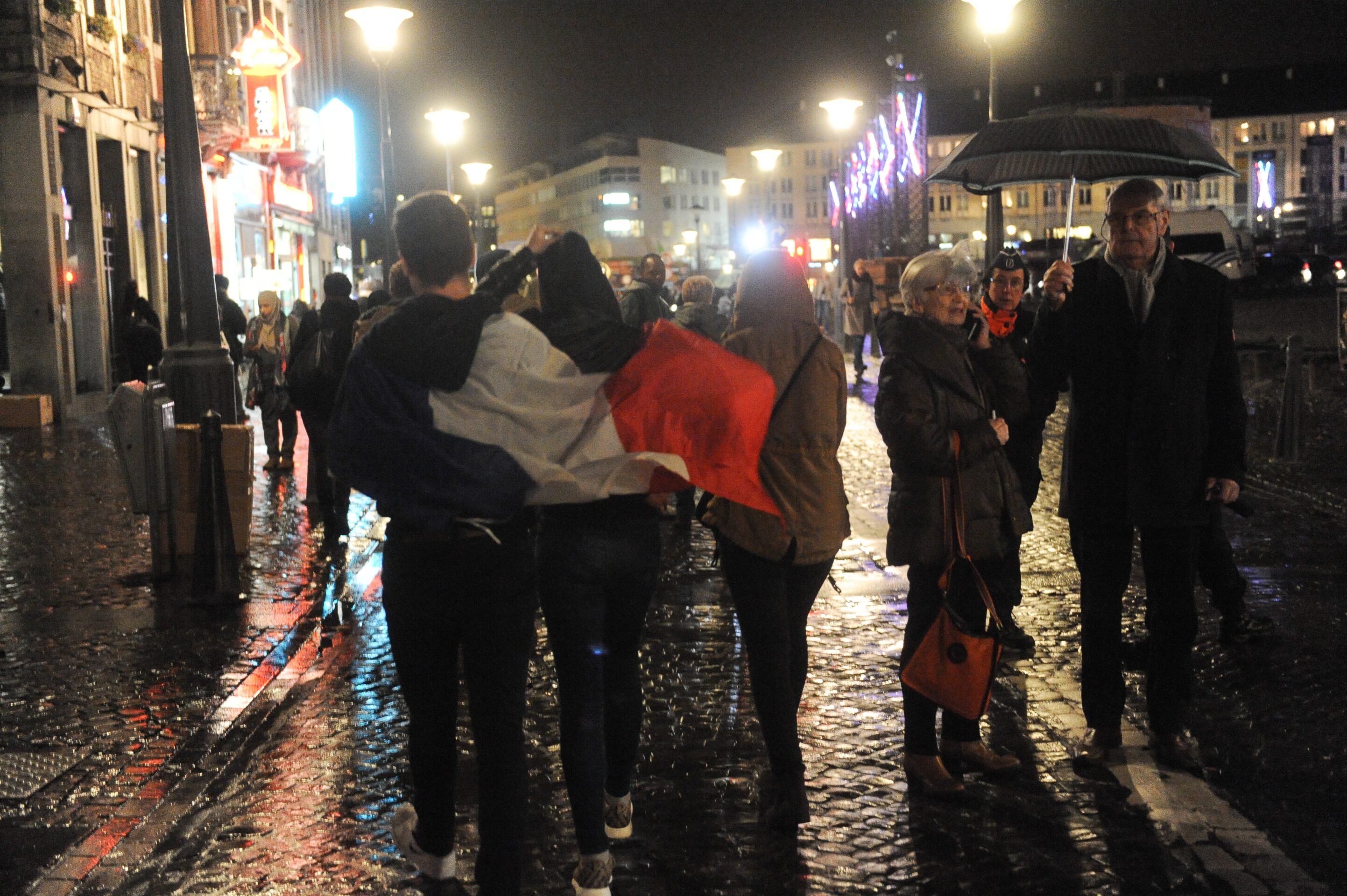
I saw one couple on the pavement, hugging each other for a sustained moment, maybe five full minutes. Two people, covered in gold thermal blankets, standing in silence, in each other's arms, heads closely together. It was an image that stayed with me.
More people were coming out now, walking across the street and through the crowd. One couple passed by me - they said they were going home. I walked alongside some of them, trying to get a reaction - balancing my goal of obtaining their testimony with the need to remain respectful.
By 3 a.m., I felt I had gathered enough material to piece together, more or less chronologically, what had happened inside the Bataclan. I said goodbye to a few fellow reporters and photographers and went home to sleep.
My reflections on 13 November, 10 years on
Looking back and rereading my notes, I see myself 10 years ago, at 27. I remember being emotionally detached that night - fuelled by adrenaline and focused on the job.
Nevertheless, this terrorist attack - and the many I would go on to cover - did affect me personally. Terrorism, violence, and war form a dark world that can be compelling to write about in many ways.
These notes, too, contain moments not only of anguish and trauma, but also of beauty, like the composed - but presumably terrified - middle-aged father, waiting calmly at the edge of the security perimeter for his daughter to appear. In the midst of calamity, people are often capable of extraordinary patience and kindness.
Thinking back to that time, I remember how unbelievable the events of that night felt. Most of us had never witnessed, or even imagined, such extreme violence unfolding in our own cities - sometimes right on our doorsteps. That has changed.
My impression is that, on the night of November 13, 2015, the world momentarily stood still in shock. I’m not sure we would react with the same astonishment if something similar happened today.
Related News
- Shots fired at home in Brussels overnight
- Bataclan survivor group reconcile with director of controversial docudrama
- How Belgium moved on from the bombings
- How the bombs changed Brussels, and how the city is still coming to terms with them
- Police call for help identifying Belgian man found dead in the woods
- EU court rules alcohol-free products cannot be labelled as 'gin'
