
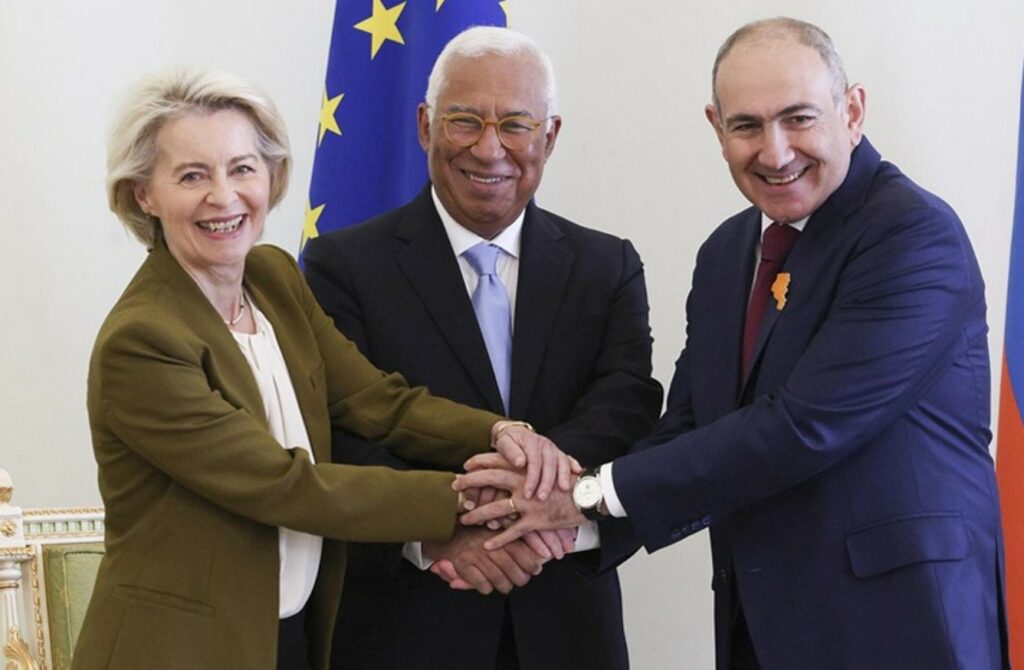
The European Union on Thursday approved financial and trade support for Armenia after Russia imposed import restrictions in response to Yerevan’s pro-European shift.
The measures, first announced by the European Commission in early July, will liberalise about 80% of Armenian exports to the EU by suspending customs duties on a wide range of products, including some agricultural goods.
The temporary preferential arrangement will remain in force for two years, the 27 member states said in a statement.
Related News
- EU agrees 2-year tariff suspension for Armenia amid conditional trade liberalisation
- EU launches mission in Armenia to combat modern hybrid threats
- EU offers €52m, bolstering Armenia amid Russian trade squeeze
Moscow, which has publicly criticised Armenia’s stated intention to distance itself from its traditional ally, imposed bans and restrictions in late May on a range of Armenian imports, including fruit, vegetables and flowers.
Those measures came ahead of Armenia’s parliamentary elections on 7 June, which were nonetheless comfortably won by Prime Minister Nikol Pashinyan’s party.
Before the summer, European Commission President Ursula von der Leyen said the EU measures were expected to cover almost all fresh fruit, vegetables and plants previously exported by Armenia to Russia, as well as more than 90% of the country’s beverage and spirits exports.
Russia said the import restrictions were based on health concerns, without giving further details, but they were widely seen as an attempt to exert economic pressure on Pashinyan.
The Armenian prime minister has moved to strengthen ties with the West while saying he wants to preserve strong relations with Russia, which continues to regard Armenia as part of its sphere of influence.
