
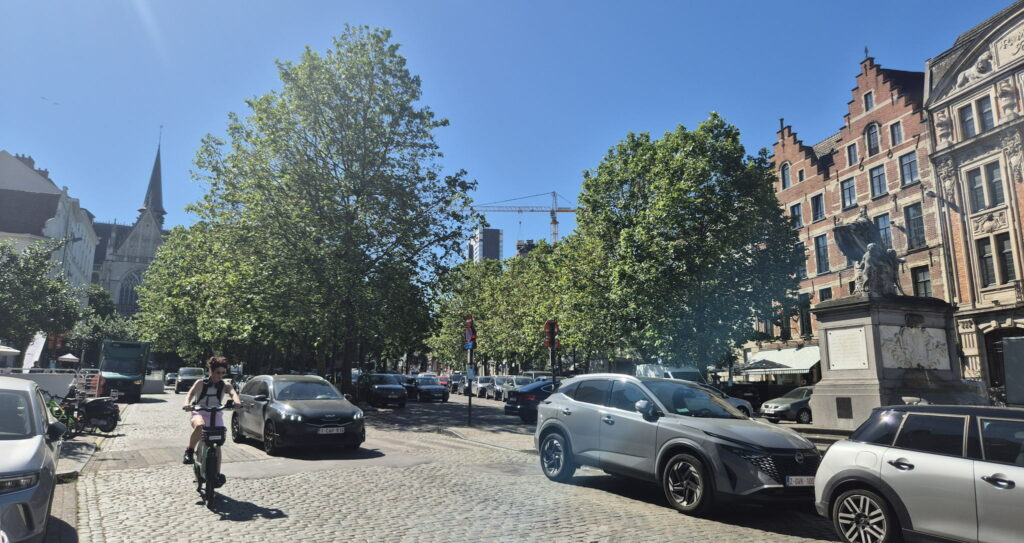
The City of Brussels has launched a redevelopment process for the Sablon, one of the capital’s most iconic squares, with authorities promising a greener, more elegant and more accessible public space shaped through a large-scale public consultation.
City officials unveiled the first details of the project, describing it as part of a broader transformation of Brussels’ historic centre aimed at strengthening links between the upper and lower parts of the city.
The redevelopment will focus on improving the quality of public space while preserving what officials describe as the Sablon’s “unique identity” - a neighbourhood known for its antique dealers, art galleries, markets, cafés and historic heritage.
“The Sablon is an iconic Brussels neighbourhood, with a rare mix and identity that must be preserved and enhanced,” said Anaïs Maes (Vooruit), the City of Brussels’ councilwoman for Urban Planning and Public Space. “Today, we are in a real momentum: the entire historic centre is evolving and the connections between the upper and lower parts of the city are gradually being strengthened.”
Greener public space and mobility rethink
The City says the redesigned square should become more welcoming for residents, visitors, traders and pedestrians, with increased greenery and improved comfort for cyclists and walkers.
At the same time, authorities also want to rethink mobility and parking around the square. The current layout of the central parking area was described by the City as “chaotic”, with officials pledging to work with residents and local stakeholders to identify alternative solutions.
The future redevelopment will also integrate a strong heritage component. According to a historical and heritage study commissioned by the City, the site holds “exceptional historical, architectural and landscape value.” Contemporary artwork is also expected to become part of the project through a dedicated selection process involving an artist working alongside the design office.
The Sablon redevelopment follows several other major public-space projects in central Brussels in recent years, including the pedestrianisation of the city centre and redevelopment works around Rue de la Régence and Place Royale.
“A coherent urban vision is taking shape,” Maes said. “The redevelopment of the Sablon is fully part of this dynamic.”
Extensive participation process
City authorities stressed that the project is still in its early stages and will involve a lengthy consultation process running until 2028. The participatory phase officially began this week with the launch of a public survey open to residents, traders and users of the square. Authorities will then carry out a “social mapping” of the neighbourhood to identify stakeholders and organise initial meetings.
Throughout autumn 2026, the City plans to gather concerns and expectations from local actors before setting up several interest groups during the winter. In 2027, those groups will take part in co-creation meetings with the City and a citizens’ jury bringing together representatives from different backgrounds and interests.
The first proposals from a design office are expected to be discussed later that year before a preliminary draft project is presented publicly.
Frederik Ceulemans (Anders), the City’s councilman for Citizen Participation, acknowledged that the redevelopment touches on sensitive issues including parking, heritage and greenery. “We know that many interests are at stake, from residents to passers-by, from restaurateurs to antique dealers,” he said. “That is what makes the Sablon so unique.”
